Stock Market Data: End-of-Day vs Real-Time for Swing Traders
A clear comparison of end-of-day vs real-time stock market data for swing traders—when each data type wins, how it affects setup quality and execution, what it does to backtests, and how to weigh cost against signal value.
Stock Market Data: End-of-Day vs Real-Time for Swing Traders
A clear comparison of end-of-day vs real-time stock market data for swing traders—when each data type wins, how it affects setup quality and execution, what it does to backtests, and how to weigh cost against signal value.
If you’re a swing trader, the data question isn’t “what’s best?”—it’s “what’s necessary for how you trade?” End-of-day charts can keep you focused and consistent, while real-time feeds can tempt you into reacting to noise.
This comparison helps you choose intentionally. You’ll see where EOD is enough, where real-time protects your entries and stops, what hidden limitations can distort signals, and how to judge whether paying for speed actually improves your decisions—not just your screen time.
Decision Snapshot
Swing traders hold positions for days to weeks, so your edge usually comes from better setups, not faster quotes. Still, data speed can change outcomes when your entry window is tight, your risk is defined intraday, or your alerts depend on immediate prints. By criterion, expect end-of-day (EOD) to win on cost and cleanliness, and real-time to win on execution timing and workflow certainty.
Who this is for
If you enter near the close, place orders after hours, or plan trades off daily charts, EOD data often fits your tempo. If you scale in during the day, trade breakouts as they trigger, or manage stops actively, real-time can prevent stale decisions. Data speed matters when minutes change your entry, not when the daily candle is the signal.
Speed is only “alpha” when it changes your order, not your opinion.
Quick winner grid
Pick your default based on what you’re optimizing, not what sounds professional.
- Cost: EOD — cheaper feeds and fewer add-ons.
- Execution timing: Real-time — entries and stops reflect current prints.
- Setup quality: EOD — cleaner bars, less intraday noise.
- Workflow reliability: Real-time — alerts and fills match what you see.
If you routinely act intraday, “good enough later” becomes “wrong now.”
Key trade-offs
EOD data is cheaper, calmer, and usually enough for daily-chart decisions. Real-time data is faster, noisier, and better aligned with how brokers execute during the session. Your context decides which pain you can tolerate: paying more for immediacy, or accepting lag for simplicity.
Choose the feed that matches when you commit risk, not when you do your research.
Data Basics Compared
Swing trading lives between the open and the close. Your edge often depends on which “version of the market” your data shows.
End-of-day (EOD) and real-time data can both be “accurate,” yet still disagree in ways that change entries, exits, and backtests.
What counts as EOD
EOD data is a completed bar for a defined session, usually daily OHLCV. It’s anchored to the exchange’s official close and settlement conventions, not your chart’s vibe.
Vendors typically publish EOD after they finalize corrections, apply corporate actions, and generate adjusted series. Adjustments may rewrite history for splits and dividends, while “unadjusted” preserves the raw tape.
If your vendor posts at 4:05 and another posts at 7:00, you’re not seeing different markets. You’re seeing different processing rules.
What counts real-time
Real-time data is a stream of quotes and trades as they happen, delivered tick-by-tick or in small aggregates. It can include Level 1 (best bid/ask, last trade) and Level 2 (multiple venues and price levels).
Most “real-time” feeds still batch, smooth, or consolidate prints, especially on retail platforms. Latency can come from your broker, your data vendor, routing, or your own internet.
For swing traders, real-time is less about microseconds. It’s about whether today’s range and volume are forming truthfully.
Hidden data limitations
The traps usually hide in the fine print. They show up when your chart and your orders stop agreeing.
- “Real-time” is often delayed by policy
- Odd-lot prints may distort last price
- Corporate actions can update after your backtest
- Session boundaries change the day’s OHLC
Audit your feed before you audit your strategy.
Setup Quality
Swing setups live or die on clean structure. Your data choice decides whether you see the pattern or chase the wiggles.
Trend and structure
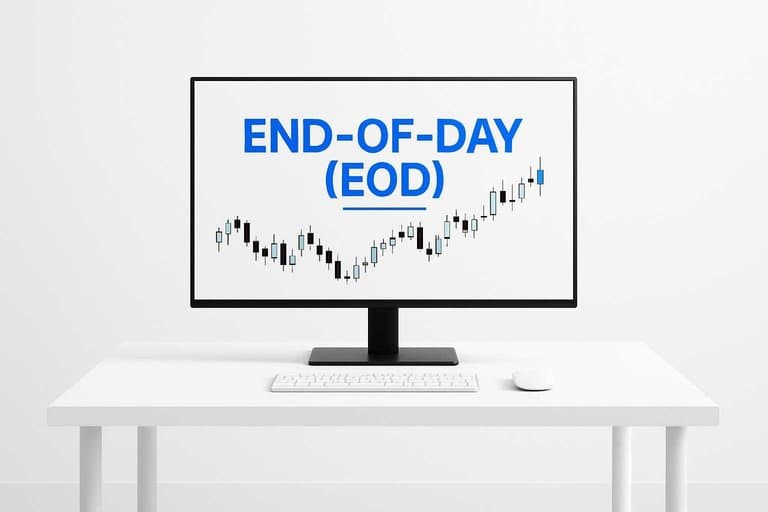
End-of-day (EOD) data usually wins because it compresses the day into decisions, not reactions. The open, high, low, and close capture the battle without the mid-fight flinching.
For trendlines, breakouts, and multi-day patterns, you care about where price settled. A daily close above resistance is a clearer signal than five intraday pokes that fade. That clean candle body also plays better with common swing tools like moving averages and prior-day levels.
Use EOD when you want structure to stay stable long enough to act on it.
Intraday noise control
Real-time data adds signal, but it also adds ways to get baited. If you watch it, you need rules that reduce randomness.
- Opening volatility whipsaws early entries
- Low-liquidity prints distort levels
- Spread jumps fake micro-breakouts
- Algorithmic sweeps trigger stop runs
- News headlines create knee-jerks
If you still use real-time, add simple filters:
- Wait for a bar close
- Require level retest
- Check volume confirmation
- Use wider invalidation
- Ignore first 15 minutes
Either you filter the noise, or it filters your account.
Gap and catalyst days
Real-time data wins when the market skips your EOD map. Gaps, halts, and news-driven moves can invalidate a swing thesis before the daily candle ever prints.
On catalyst days, you are managing risk more than optimizing entries. You watch for fast reclaim failures, failed breakaway gaps, and halts that change the entire auction. A swing setup can go from valid to broken in minutes, and EOD will tell you too late.
Use real-time on days where time itself becomes the stop-loss.
Timing and Execution
Your data choice changes how you enter, how you protect, and how you plan. Swing trading lives between the close and the next open, so the “right” feed depends on where you place decisions.
Entry timing windows
End-of-day data wins when your decision happens after the close and your execution is simple. Think: place a market-on-open order, a limit near a level, or a stop-entry for the next session.
Real-time wins when your entry depends on an intraday condition. Examples include a breakout trigger, a reclaim of VWAP, or a pullback fill inside the session.
If your trigger lives inside the candle, you need the tape, not the timestamp.
Stop management
Some stop styles require live data because the decision is conditional and time-sensitive. Others are fine with end-of-day levels because the rule is based on closes or daily extremes.
- Hard intraday stop-loss orders need real-time monitoring
- Trailing stops based on intraday lows need real-time prints
- Time-based exits during the session need real-time alerts
- Close-based stops can use EOD close values
- Wide thesis stops can use EOD highs/lows
Pick the stop first, then buy the data that can enforce it.
Fill risk reality
Real-time data helps you see spreads widen, liquidity thin, and price jump through levels. It lets you react when a clean chart setup turns into a messy auction.
Better fills usually come from better order design, not faster charts. A patient limit, realistic trigger price, and awareness of thin names often matter more than milliseconds.
Use real-time to avoid bad conditions, not to chase “perfect” entries.
For more context on how execution quality is measured (including effective spreads), see FINRA’s overview of SEC Rule 605 execution-quality reporting.
Backtesting Reliability
Swing traders care about backtests that behave like live trading, not just pretty equity curves. The dataset you choose decides how many hidden assumptions sneak in.
Historical cleanliness
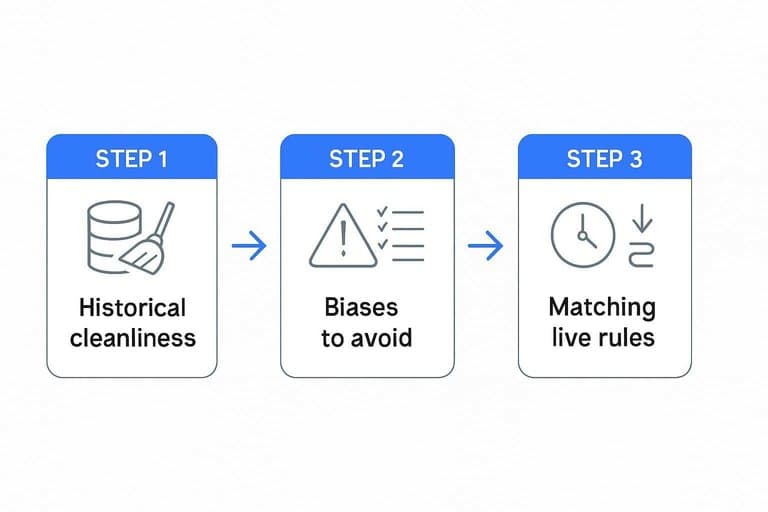
End-of-day data is usually cleaner because it collapses chaos into one agreed-upon bar per session. That makes backtests more repeatable across vendors and easier to audit.
With EOD, you typically get consistent session boundaries, standardized OHLCV bars, and fewer “ghost” gaps from missing prints. Adjustments for splits and dividends are also simpler, because you reconcile one bar per day instead of thousands of ticks with shifting timestamps.
Cleaner history doesn’t guarantee a profitable strategy, but it does reduce false confidence from messy microstructure.
Biases to avoid
Either dataset can lie to you if your pipeline bakes in the wrong assumptions. Verify these before trusting any backtest.
- Survivorship bias in your symbol universe
- Lookahead in signals and fills
- Corporate action adjustment method
- Session hours and holiday calendar
Fix these first, because “better data” can still produce a broken test.
Matching live rules
Real-time data matters when your strategy depends on the path prices took, not just the close. If your entry or exit can trigger mid-session, EOD bars can hide the exact sequence.
You need intraday data for stop and limit behavior, bracket order logic, and time-based exits that fire at specific minutes. Otherwise, your backtest will grant fills your broker never would.
When execution rules are intraday, test intraday, or you’re testing a different strategy.
Cost vs Value
For swing trading, the real cost question is rarely “Can I afford real-time?” It’s “Will real-time change enough decisions to justify the friction?”
End-of-day data often covers your research loop. Real-time earns its keep when it changes entries, exits, or risk actions while you can still act.
Typical cost drivers
Real-time pricing climbs fast once you move beyond a single top-of-book feed. Most of the jump comes from who you are, what you pull, and how many venues you cover.
- Exchange redistribution and access fees
- Professional vs non-professional entitlements
- Depth-of-book and Level II data
- Multi-venue aggregation and normalization
- Low-latency delivery and APIs
If you need three of these, you’re buying infrastructure, not just quotes.
To see how these charges show up in practice, review the NYSE market data fee schedule.
Value threshold
Real-time starts paying for itself when your edge depends on intraday choices. That usually means you adjust orders during the session, or you run tight risk rules.
Imagine you place entries on breakouts and you cancel quickly when the setup fails. If your decision is made at 10:30, yesterday’s close is trivia.
If you only act after the close, spend on better process first.
Budget-friendly stacks
Pick a stack based on how often you change your mind during market hours. Start simple, then add real-time where it closes a specific gap.
- EOD-first: Use end-of-day bars, corporate actions, and basic alerts for after-hours planning.
- EOD-first: Add robust journaling, backtesting, and watchlist scoring for weekly reviews.
- Hybrid: Keep EOD for research, then add real-time last trade and top-of-book for execution windows.
- Hybrid: Add intraday alerts and bracket-order support for fast risk responses.
- Hybrid: Add limited depth-of-book only if slippage or liquidity is your bottleneck.
Buy the layer that prevents a bad trade, not the one that looks impressive.
Signal Types Scorecard
Different swing-trader signals want different “freshness.” Use this scorecard to pick the cheapest data that still protects your entries and exits.
| Signal or decision | EOD wins when | Real-time wins when | Typical choice |
|---|---|---|---|
| Trend filter | You trade daily closes | You adjust intraday | EOD |
| Breakout entry | Close confirms range break | You enter on trigger | Real-time |
| Gap-and-go avoid | You check opens only | You manage gap risk live | Real-time |
| Stop-loss execution | You place at close | You need fast exits | Real-time |
| Earnings risk | You plan around calendar | You trade reaction | Real-time |
Buy real-time for execution, not for comfort. If you can’t act on the tick, don’t pay for it.
Choose Your Data Like a Rule, Not a Preference
Pick EOD when your edge comes from daily trend, structure, and repeatable end-of-session rules; add real-time only when your strategy depends on intraday triggers, precise stop handling, or managing gap/catalyst risk. Whatever you choose, mirror it in your backtests—same timestamps, same entry windows, same order assumptions—so your results translate to live trading. Then let cost be the final filter: pay for faster data only if it measurably reduces decision errors or execution surprises in the specific signals you trade.
Frequently Asked Questions
Do swing traders need Level 2 data or is basic real-time data for stock market enough?
Most swing traders can do fine with basic real-time quotes and daily bars; Level 2 is mainly useful if you’re actively managing limit orders around liquidity or slippage. If you place orders near the close or at the open, Level 2 can help you avoid thin prints and wide spreads.
What’s the best way to verify a “real-time” stock market data feed is truly real time and not delayed?
Check the vendor’s exchange agreements and the stated delay (e.g., “15-minute delayed”) in the data settings or account plan details. You can also compare the last trade time and bid/ask updates against a broker platform known to be real time.
Can I use free data for stock market (like Yahoo Finance) for swing trading analysis and backtesting?
Free sources can work for idea generation and rough chart review, but they often have limitations like adjusted pricing differences, missing corporate action details, or inconsistent intraday history. For backtesting or rule-based signals, use a paid dataset or your broker’s historical data with clearly documented adjustments.
How do I choose between broker-provided data for stock market and a dedicated data vendor?
Broker data is usually simplest for execution and basic charting, while dedicated vendors are better when you need clean historical data, APIs, or consistent symbol coverage across markets. Choose based on whether your workflow depends more on automation, historical depth, or multi-asset scanning.
What data for stock market should I track to avoid earnings and corporate-action surprises as a swing trader?
Use an earnings calendar plus corporate actions data (splits, dividends, symbol changes) and make sure your charting/backtest data is adjusted consistently. Most traders add basic news alerts for earnings/pre-announcements to avoid holding through high-volatility events unintentionally.
Simplify Your Daily Data
Choosing between end-of-day and real-time data is only half the battle—the real edge comes from turning that data into a repeatable daily watchlist.
Open Swing Trading helps you rank leadership, track breadth, and spot sector/theme rotation with end-of-day updates across ~5,000 stocks—get 7-day free access with no credit card.
Sources
- FINRA — SEC Rule 605 overview (execution quality; effective spreads) — referenced in Fill risk reality
- NYSE — Proprietary Market Data Fee Schedule (PDF) — referenced in Typical cost drivers