
6 Day Stock Trading Styles: Use Each When
A practical collection of six day-trading styles and when to use each—match time window and temperament to market context, spot key setup cues, apply entry/management frameworks, and avoid the most common risk traps and failure modes.
6 Day Stock Trading Styles: Use Each When
A practical collection of six day-trading styles and when to use each—match time window and temperament to market context, spot key setup cues, apply entry/management frameworks, and avoid the most common risk traps and failure modes.
You can have a solid setup and still lose money just because you’re trading the wrong style for the day in front of you. Choppy midday price action punishes momentum; a clean trend makes constant fading feel like death by a thousand cuts.
This collection helps you choose intentionally. You’ll learn how to align your time window and temperament with the market context, what conditions favor scalps vs. trends vs. reversions, and the specific cues that say “yes,” “not today,” or “stand aside.”
Choose Your Style
A day trading style is your operating mode: how long you hold, how often you act, and how you manage attention. A strategy is the specific playbook inside that style, like a breakout rule set or a pullback entry. Pick the style first, then fit strategies to your time, temperament, market, and tools.
Time Window Fit
Different styles demand different screen time and decision speed, even if the same strategy signals appear. Use the table to pick the mode you can actually run on your schedule.
| Style | Typical hold | Screen time | Decision speed |
|---|---|---|---|
| Scalp | Seconds–minutes | Full-time | Instant |
| Momentum day trade | Minutes–hours | High | Fast |
| Trend intraday | Hours | Medium | Moderate |
| Mean reversion | Minutes–hours | Medium | Moderate |
| News/event | Minutes | Full-time | Very fast |
Treat this as a lifestyle choice first; mismatch here kills execution.
Trader Temperament
Your style has to feel sustainable when you’re wrong, bored, or stressed. Risk tolerance, patience, and decisiveness decide whether a style fits your nervous system.
A reactive trader often does better with scalps or news moves, where “hesitate and you miss it” is normal. A patient trader often prefers trend intraday, where waiting is part of the edge. If you hate being whipsawed, mean reversion can feel brutal; if you hate chasing, momentum can feel worse.
Pick the style that makes your mistakes smaller, not just your wins bigger.
Market Context
Markets change, and some styles only work when the tape gives you room. Match your style to what’s actually happening, not what you wish was happening.
- Scalp: tight spreads, deep liquidity, steady micro-volatility
- Momentum: strong trend, expanding volume, clean breakouts
- Trend intraday: directional day, orderly pullbacks, low chop
- Mean reversion: range-bound action, fading extremes, stable liquidity
- News/event: heavy news flow, volatility spikes, fast repricing
When conditions flip, switch styles or stand down; forcing it is the expensive habit.
Scalping
Scalping is ultra-short-term trading that aims to capture small price moves repeatedly. It shines when you can execute cleanly, because friction eats the edge fast.
Liquidity, tight spreads, and reliable fills are non-negotiable. If those inputs are weak, your “strategy” becomes a fee-and-slippage donation.
Use Scalping When
Scalping fits when your environment is built for speed and precision. You’re hunting small, repeatable edges, not big narratives.
- Trading high-liquidity tickers
- Getting tight, stable spreads
- Using fast, reliable platforms
- Staying focused for long stretches
- Benefiting from low-latency execution
If you can’t control execution quality, you don’t have a scalping edge.
Avoid Scalping When
Scalping breaks when costs and emotion take over. Small mistakes stack fast.
- Facing wide, jumpy spreads
- Trading choppy, illiquid names
- Experiencing slow fills or freezes
- Feeling urge to overtrade losses
- Paying meaningful fees per trade
When friction is high, patience beats speed.
Key Setup Cues
Scalpers lean on microstructure cues that signal short bursts of imbalance. You’re reading what price is likely to do next, not what it “should” do.
Order-book pressure shows up when bids or offers keep refreshing and absorbing hits, then price nudges through. Micro breakouts appear when price coils in a tight range, then pops with immediate follow-through. VWAP reclaims matter when price slips below, then snaps back and holds above on active prints.
Treat these as context filters, then demand clean execution.
Momentum Trading
Momentum day trading means riding a strong intraday move while it’s still being powered. The fuel is usually a catalyst or order flow, not your opinion about “fair value.”
Use Momentum When
You want momentum when the tape has a reason to keep pushing and enough participation to stay clean.
- A fresh catalyst hits the wire
- Relative volume is clearly elevated
- Key levels break and hold
- Volatility expands, not compresses
- Sector names move in sympathy
Momentum works when crowd attention is concentrated and late buyers still exist.
Entry Framework
Use a repeatable checklist so you’re trading the move, not the adrenaline.
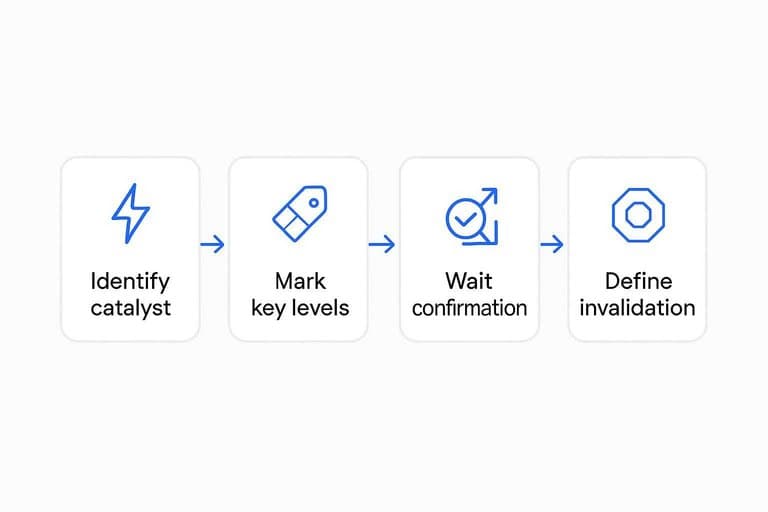
- Identify the catalyst and likely audience.
- Mark premarket high/low, VWAP, and prior-day levels.
- Wait for confirmation: break, hold, and retest or tight flag.
- Plan scaling: starter, add point, and max size limit.
- Define invalidation: the price level that proves you wrong.
Your edge is structure around speed, not speed by itself.
Risk Traps
Momentum punishes impatience because the best entries often look “too late” at first. Chasing extended candles usually means you’re buying where strong hands are selling.
Halts can reset the order book and reopen at worse prices than your stop assumed. Liquidity can also vanish after the first burst, especially when volume fades and spreads widen.
If the move loses volume and stops making new highs cleanly, you’re no longer trading momentum. You’re trading hope.
Trend-Following Intraday
Intraday trend trading means you stay with a clear move and accept normal pullbacks. You trade the market’s structure, not your need to constantly “get back in.”
Imagine a stock grinding up all morning, dipping to a prior swing low, then pushing to a new high. Your job is to hold the pullback and only bail when the trend breaks.
Use Trend When
Trend trades work best when the tape is already behaving like a trend day. You want clean continuation, not random spikes.
- Higher highs and higher lows
- Pullbacks are smooth and shallow
- Index or sector provides tailwind
- Price respects VWAP or key MAs
If pullbacks look orderly, you’re probably trading a trend, not a headline.
Trade Management
You win this style with planning and patience, not faster clicking.
- Pick your trend timeframe and key structure levels.
- Enter on a pullback into support, not at the highs.
- Trail your stop under the last clean swing level.
- Take partials at extensions into prior highs or measured pushes.
- Exit on a clear reversal, not a scary candle.
Your edge is staying in while others flinch.
When It Fails
This style breaks on range-bound days, where “trend” is just two pushes and a fade. It also struggles after sudden reversals, lunchtime chop, or when the index acts mean-reverting and snaps back to VWAP.
When price keeps reclaiming and losing the same levels, stop hunting trends and start respecting the range.
Mean Reversion
Mean reversion day trading is a style where you bet a stretched price snaps back toward “normal,” like VWAP or the range midpoint. You use it when conditions are stable enough that extremes tend to get sold or bought back, rather than turning into a trend day.
Use Reversion When
You want reversion when price is stretched but structure still looks contained.
- Trade a clean range day
- Fade an emotional spike
- Sell or buy far from VWAP
- Lean on clear support/resistance
- Act as volatility shrinks
If volatility expands and holds, stop fading and start respecting trend.
Confirmation Checklist
You need evidence the move is tiring, not just “high” or “low.”
- See exhaustion wicks or stalls
- Spot momentum divergence
- Watch a breakout fail fast
- Find liquidity at key levels
- Place stop beyond extreme
No stop location means no trade; that’s the line that gets crossed.
Control the Risk
Reversion works until it doesn’t, and the “doesn’t” is violent. Your edge comes from small, repeatable losses and letting only clean snaps pay.
A planned fade has a level, a stop, and size that survives a second push. “Catching knives” is entering because it feels far, then hoping.
Breakout Trading
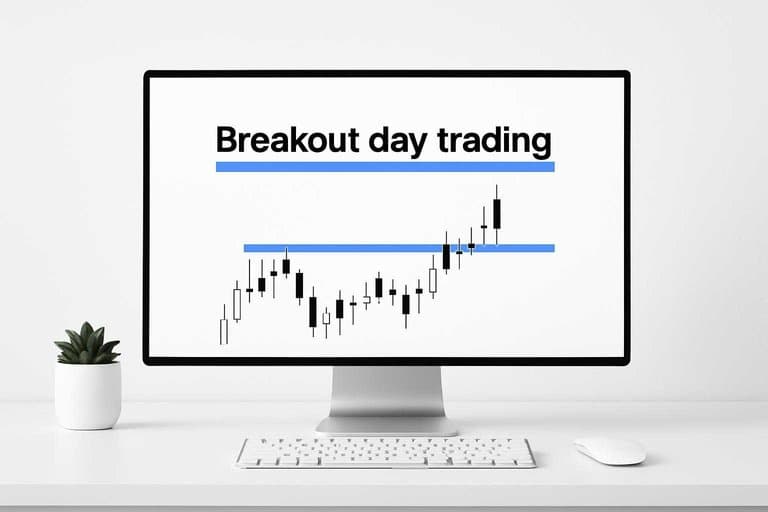
Breakout day trading is buying or shorting when price pushes through a well-defined level and tries to run. You trade it because trapped orders and fresh momentum can create fast, clean moves.
Quality breakouts usually share three traits: real liquidity, visible compression, and a level everyone can see. Without those, you’re often just chasing noise.
Use Breakouts When
Breakouts work best when the chart is coiled and the level is obvious. You want conditions that can attract follow-through, not just a one-tick poke.
- Tight consolidation near a key level
- Fresh catalyst that changes attention
- Rising volume into the level
- Clean premarket highs or lows
- Market trend supports your direction
If two or more are missing, trade smaller or skip it.
Breakout Playbook
A breakout is a plan, not a feeling.
- Mark the level and the nearby “line in sand.”
- Define the trigger, including required volume or tape speed.
- Choose entry: stop order, pullback entry, or reclaim entry.
- Place the stop where the setup is invalid, not where it hurts less.
- Take first profit into the next obvious liquidity pocket, then manage false breaks.
Your edge comes from the invalidation point, not the entry.
False Break Signals
False breaks fail fast because the market rejects the new price. Spotting that rejection early keeps a small loss from turning into a thesis.
Watch for immediate reclaim back under the level, especially on weak volume. Long wicks, stalled tape, broad market divergence, or a breakout straight into overhead supply are classic failure cues.
When the breakout can’t hold the level, treat it like an exit signal, not a debate.
News-Driven Trading
News-driven trading is about capturing fast repricing when new information hits the tape. It works because liquidity, volatility, and attention all surge at once. Your edge comes from preparation, execution speed, and strict participation rules.
Use News When
News works best when the catalyst is clear and the market is likely to care immediately.
- Trade earnings releases and calls
- Trade CPI, jobs, and Fed decisions
- Trade upgrades, downgrades, and target changes
- Trade guidance changes and pre-announcements
- Trade M&A headlines and deal updates
Trade the reaction, not the headline.
Pre-News Prep
Do this before the event, or you will end up chasing.
- Check the calendar and exact release times.
- Define no-trade zones around the first spike.
- Mark key levels from premarket and prior day.
- Pre-set alerts, triggers, or conditional orders.
- Pick the instrument and size for wider spreads.
Your plan should decide for you when the first move tries to bait you.
Safety Rules
News spikes can look tradable while being structurally untradeable. Spreads widen, quotes flicker, and fills get ugly, especially in thin names.
Avoid illiquid movers that gap on a few prints. Respect halts and reopen auctions, because price discovery is not continuous there. Cap your daily loss so one headline does not own your week. Wait for spreads to normalize before sizing up.
If you cannot get in and out cleanly, you do not have a trade.
Style Comparison Table
Pick a style by matching it to your schedule, your tools, and your tolerance for fast feedback.
| Style | Holding time | Screen time | Volatility needs | Tools required | Stress level | Common mistakes |
|---|---|---|---|---|---|---|
| Scalping | Seconds–minutes | Constant | High, tight spreads | Level II, hotkeys | Very high | Overtrading, fees ignored |
| Momentum day trading | Minutes–hours | High at open | Medium–high | News, charts | High | Chasing, late entries |
| Range trading | Minutes–hours | Moderate | Low–medium | Support/resistance | Medium | Forcing ranges, ignoring breakouts |
| Breakout trading | Minutes–hours | High at levels | High at trigger | Alerts, volume | High | Fakeouts, wide stops |
| Mean reversion | Minutes–hours | Moderate | Spike then fade | Bands, VWAP | Medium | Averaging down, no stop |
| Intraday swing | Hours–close | Low–moderate | Medium | Trend tools | Medium | Holding too long, exit drift |
The best “style” is the one you can repeat on your worst, most distracted day.
Pick One Style, Then Trade It on Purpose
- Start each session by labeling the environment: trending, range-bound, volatile/news-driven, or dead/illiquid.
- Choose one primary style that fits that label and your time window (scalp, momentum, trend, reversion, breakout, or news), and define what would make you switch—or stop.
- Write your “must-have” setup cues and one invalidation level before you enter, then size the trade so a normal stop is survivable.
- Review after the close: Did the market match your chosen style, and did you execute the playbook—not improvise—when conditions changed?
Frequently Asked Questions
Is day stock trading the same as swing trading?
No. Day stock trading opens and closes positions in the same session, while swing trading holds positions overnight to capture multi-day moves.
Do I need Level 2 and time & sales for day stock trading?
Not always, but they’re often useful for styles that depend on execution and liquidity (like scalping and breakouts). For more structure-based approaches, a clean price chart plus VWAP and key levels can be enough to start.
How do I measure whether my day stock trading style is working?
Track performance by setup type using a trading journal, including win rate, average win vs average loss, and maximum drawdown. Review screenshots and notes to confirm you’re following rules rather than just making money in favorable conditions.
Can I day stock trade with a full-time job?
Yes, if you choose a style that fits limited screen time and focus on the most liquid hours you can consistently trade. Predefine watchlists, alerts, and risk rules so you’re not forced to react constantly.
How long does it take to know which day stock trading style fits me?
Most traders can narrow it down after a period of deliberate practice with one or two setups and consistent journaling. You’ll know it fits when you can follow the rules repeatedly and your results are stable across different market days.
Build Better Trade Watchlists
Once you’ve picked a day trading style, the real edge comes from finding the right stocks and knowing when the market is cooperating.
Open Swing Trading helps you spot potential breakout leaders with daily relative strength rankings, breadth, and sector/theme rotation context—use the 7-day free access with no credit card to streamline stock selection.
Related Articles
Sources
- Volume-Weighted Average Price (VWAP) | Britannica Money — referenced in Use Trend When