
5 Trading-Day Timing Mistakes That Cost Entries
A practical troubleshooter for fixing trading-day timing errors that ruin otherwise solid setups—avoid opening-bell traps, manage news-event whipsaws, adapt to lunch-hour drift, sidestep late-day liquidity pitfalls, and control overnight gap risk with clearer entry plans.
5 Trading-Day Timing Mistakes That Cost Entries
A practical troubleshooter for fixing trading-day timing errors that ruin otherwise solid setups—avoid opening-bell traps, manage news-event whipsaws, adapt to lunch-hour drift, sidestep late-day liquidity pitfalls, and control overnight gap risk with clearer entry plans.
Ever had the right idea and the wrong time—watching price rip without you, or getting clipped out the moment you enter? Most “bad trades” aren’t about the setup; they’re about when and how you executed within the day.
This troubleshooter helps you diagnose five timing mistakes that quietly cost entries. You’ll get simple checklists, risk-mapping for news, and decision rules for slow midday tape, thin late-day liquidity, and overnight gap risk—so you can choose safer execution options and know when to pass.
Missed the Opening
The open is a different market. Spreads flare, quotes refresh unevenly, and your “clean” setup turns noisy fast.
Most late entries come from execution choices, not slow reactions. Fix the mechanics first.
Classic open traps
Three patterns create late fills or no fills at the open.
- Hitting market orders into wide spreads
- Chasing breakouts of the first candle
- Ignoring opening auction mechanics
Treat the open like a separate playbook, not a faster version of midday.
Quick open checklist
Run this before you place the first order.
- Check the spread against your maximum acceptable tick or cents risk.
- Confirm liquidity at your size on the bid and ask.
- Define the first 5–15 minute range, then plan around it.
- Scan for scheduled news and fresh headlines on your symbol.
If two items fail, you’re not late. You’re early.
Safer execution options
Your order type decides whether you pay slippage or miss the trade. At the open, you often can’t avoid both.
Limit orders help you control price in wide spreads, but they can leave you unfilled. Stop-limits reduce surprise fills, but they can fail during fast moves. Waiting for the initial range to form lowers randomness, but you may give up the best entry.
If you missed it
You need rules that turn “missed” into “next setup,” not “late chase.”
- Mark the breakout level and the first pullback zone toward it.
- Only re-enter on a retest that holds, with shrinking volatility or slowing momentum.
- Place an invalidation point beyond the level that would prove the move failed.
- Skip the trade if price runs without retesting or structure.
Your edge isn’t catching every move. It’s avoiding the ones that punish impatience.
News Event Whipsaws
Scheduled data, earnings, and surprise headlines can turn clean setups into instant stop-outs. Your chart still looks “right,” but execution gets warped when spreads jump and liquidity vanishes.
Event risk map
You can’t manage event risk if you don’t name it first. Build a daily checklist that flags “noisy hours” before you pick entries.
- Major economic releases and revisions
- Central bank decisions and speaker calendars
- Earnings, guidance, and investor updates
- Sector headlines and regulatory actions
- Company-specific alerts and rumors
If you didn’t check the calendar, you didn’t have a plan.
Timing your exposure
You need a simple decision tree, not a vibe. Decide what you’ll do before the event clock starts.
- If the event hits your instrument, stand aside until after the release.
- If you must trade, reduce size and require cleaner levels.
- If liquidity is normal, widen entry criteria slightly and avoid tight stops.
- If volatility is the point, switch to post-event confirmation entries only.
Your edge is timing plus execution, not bravery.
Spread and halt shocks
News doesn’t just move price. It changes the market’s ability to fill you.
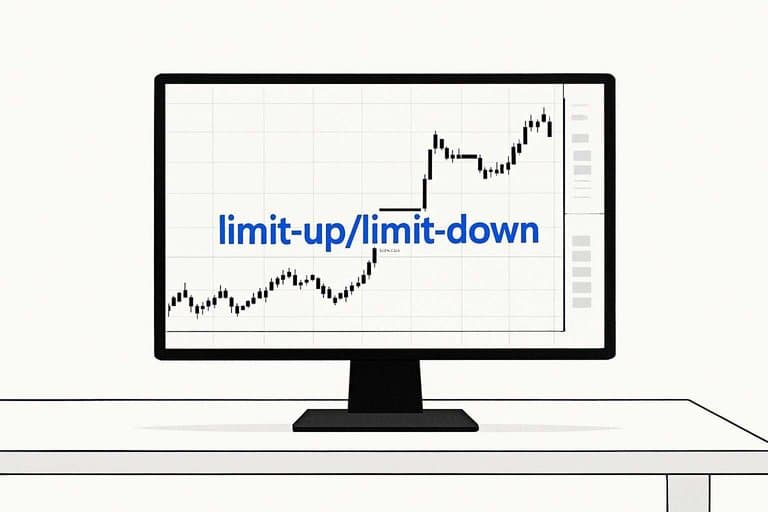
Watch for spread expansion, thin order-book depth, and prints that gap through levels. Frequent volatility halts or limit-up/limit-down pauses are another tell, because the “next” tradable price can be far from your planned entry. When that happens, breakouts and stop entries become slippage machines, and tight technical levels lose meaning.
If execution is unstable, your setup is already invalid.
Post-event entry plan
Waiting is only useful if you know what you’re waiting for. Trade the new information, not the last chart.
- Let the first impulse finish and mark the new high-low range.
- Wait for direction confirmation via a hold above or below that range.
- Set limit levels at retests, not at the spike extremes.
- Place protective stops beyond the new structure, not the old one.
Post-event entries turn chaos into structure you can actually manage.
Lunch Hour Drift
Midday often turns your clean breakout plan into a slow grind. Volume thins, spreads feel wider, and price snaps back to the mean.
In lunch hour drift, breakouts fail less because you were “wrong,” and more because the market stops rewarding urgency. This is where having clear context on whether you’re in an expansion vs. mean-reverting regime matters—tools like Open Swing Trading can help you come into the session with a tighter leader list (via daily RS and breadth/sector context) so you’re not forcing marginal midday “breakouts.”
| Mistake | What you see | Why it fails midday | Better timing cue |
|---|---|---|---|
| Chasing the first pop | Quick push, then stall | Thin volume can’t sustain | Wait for retest hold |
| Buying range highs | Repeated wicks at top | Mean reversion dominates | Enter on range edge |
| Using open-style stops | Tight stop under pivot | Random noise hits stops | Use structure-based stop |
| Ignoring spread and slippage | Fills feel worse | Liquidity pockets widen | Size down, use limits |
| Forcing “breakout” setups | Small candles, overlap | No expansion regime | Trade fades or wait |
Treat lunch like a different market regime, not a smaller version of the open.
(Evidence for the midday liquidity/spread regime is consistent with the well-known U-shaped intraday pattern in volume and bid-ask spreads.
Late-Day Liquidity Traps
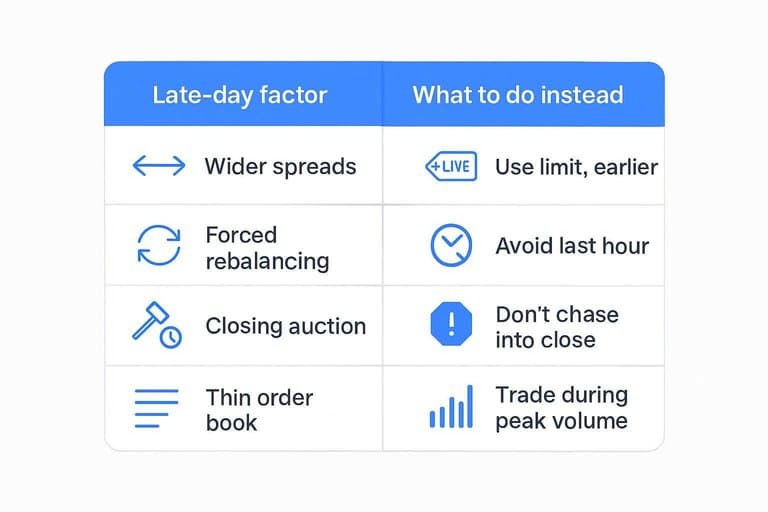
Late-day entries look convenient because the session is almost done. They also hide microstructure landmines that change fills, stops, and your real risk.
Late-day traps to watch:
| Late-day factor | What you see | What it does | What to do instead | |—|—|—| | Wider spreads | Quotes drift apart | Worse entry price | Use limit, earlier | | Forced rebalancing | Sudden one-way flow | Slippage, whipsaws | Avoid last hour | | Closing auction | Big print at close | Fill far from mid | Don’t chase into close | | Thin order book | Smaller displayed size | Stops trigger easily | Trade during peak volume |
Trade when spreads are boring and books are thick, not when closing mechanics take over.
Overnight Gap Surprises
Intraday entries can look clean, then get wrecked by the next open. Gaps ignore your stop, change liquidity, and force you to trade a new chart.
Your job is to spot “gap-prone” setups early, then choose a plan that survives the session transition.
Gap risk signals
Some setups are fine at 2:00 pm and fragile at 9:30 am. You want to flag anything where an overnight print can jump your risk.
- Holding through earnings or guidance
- Thin after-hours or premarket liquidity
- High headline sensitivity in the sector
- Nearby support with little room
If two or more show up, treat it like an overnight coin flip.
Positioning alternatives
You don’t have to choose between “full size” and “no trade.” You can keep the idea while changing how you express it.
Smaller size reduces the damage if price opens through your level. Options can define risk, or hedge overnight exposure with a paired position. You can also wait for the next day to confirm, then enter with the open’s information.
Your edge isn’t the entry. It’s controlling the gap’s ability to rewrite your risk.
Next-day entry steps
Gap mornings need predefined playbooks, not improvisation. Pick the scenario, then write the trigger and the “I’m wrong” level.
- Classify the open: gap-and-go, gap-fill, or gap-reversal.
- Set the trigger: break premarket high, VWAP reclaim, or range failure.
- Place limits: max slippage, max spread, and size cap.
- Define invalidation: level that proves the thesis wrong.
- Require confirmation: first pullback, opening range break, or volume check.
If you can’t write the invalidation in one line, you’re guessing.
When to skip trades
Some opens are structurally untradeable. You don’t fix them with better chart reading.
- Spreads are wide or flickering
- Premarket range is messy or absent
- Higher timeframe trend conflicts hard
- Catalyst is unclear or unverified
Skipping is a position. Protect your entries for days when the market is actually offering one.
Turn Timing Into a Repeatable Entry Routine
- Label the regime first: open, post-open, midday, late day, or overnight—then trade only the playbook that fits that window.
- Map the day’s landmines: scheduled news, expected volatility, and liquidity conditions; size and order type should follow the risk, not the chart.
- Choose the safer execution: if conditions are fast or thin, default to smaller size, limit/stop-limit, predefined invalidation, or waiting for confirmation.
- If you missed it, don’t chase it: switch to a “next clean entry” plan (pullback, retest, or break-and-hold) or skip.
- Review with one question: was it a setup problem or a timing problem—then adjust the time-of-day rules before the next session.
Frequently Asked Questions
What is the best time of day to place trades during a trading day if I want reliable liquidity?
Most traders get the most reliable liquidity during the mid-morning after the opening volatility settles and again in the early afternoon before the close. Use your platform’s volume profile or time-and-sales to confirm that spreads and depth are stable in your specific market.
How do I adjust my order type to reduce bad fills during the trading day?
Use limit orders when spreads are wide or price is moving fast, and consider stop-limit (not stop-market) when you need a trigger but want fill control. If you must use marketable orders, cap position size so slippage doesn’t dominate your risk.
Does the “best trading day” of the week still matter in 2026, or is that a myth?
Day-of-week patterns are usually weaker than regime and event effects, so treat them as a minor filter, not a strategy. Track your own results by weekday and exclude days that consistently coincide with your worst execution or highest headline risk.
How do I measure whether my trading-day timing is the problem versus my setup?
Journal entry timing metrics separately from setup quality: record planned entry price, actual fill, slippage, and max adverse excursion (MAE) within the first 5–30 minutes after entry. If good setups repeatedly show large slippage or immediate MAE spikes at specific times, timing/execution is the culprit.
How can I plan tomorrow’s trading day so I’m not reacting to the tape at the open?
Build a short pre-market plan: key levels, invalidate points, and a small A/B watchlist aligned with the current market regime and leading sectors. Tools like Open Swing Trading can help by narrowing candidates with daily relative strength, breadth, and sector rotation context so you start the session with higher-quality names and clearer priorities.
Trade Each Session With Context
Avoiding opening fades, news whipsaws, midday drift, late-day traps, and overnight gaps is easier when your timing is backed by daily market-regime data.
Open Swing Trading helps you spot potential breakout leaders with daily RS rankings, breadth, and sector/theme rotation—so you can time entries with clarity, not guesswork. Get 7-day free access with no credit card.
Related Articles
- 6 Day Stock Trading Styles: Use Each When
- Stock Market Data: End-of-Day vs Real-Time for Swing Traders
- How a Swing Trading Scanner Works After the Close
Sources
- SSRN — Intraday Dynamics of NASDAQ Stocks: U-shape in trading volume and bid-ask spreads (TAQ 2000–2021) — referenced in Lunch Hour Drift